Are Termite Barriers Worth It on Older Coastal Homes?
Termite barriers help, but they aren't a silver bullet. What they do, why installation quality decides everything, and why annual inspection still matters.
Yes — with caveats, and the caveats matter more than the yes.
A termite barrier is genuinely useful. It’s also routinely oversold, frequently installed badly, and almost never treated by its owner as the thing that actually determines whether it works: a system that gets broken by a later addition, a new garden bed or a downpipe change stops doing its job quietly.
So the honest answer is that barriers are worth having, and that on an older coastal property the value depends more on installation quality and ongoing inspection than on the type.
Short answer: what a termite barrier does and doesn’t do
A barrier reduces the risk of termites reaching timber through the ground. It doesn’t stop termites entirely, and it doesn’t do anything about timber that’s already in contact with the ground or above it.
That’s a narrower claim than most advertising makes, and it’s the right one. Barriers work. They’re one layer in a system that also includes ventilation, moisture management, timber detailing, and inspection.
The second thing worth saying plainly: on a home built before barriers were common, installing a barrier addresses one pathway. It doesn’t retrospectively fix timber already in contact with soil, a blocked subfloor, or a roof void that leaks.
What a barrier does — and what it doesn’t
What it does. It creates a physical or chemical separation between the soil and the timber above it, so termites moving through the ground encounter the barrier rather than continuing into the building. That’s genuinely valuable on any home with timber framing near the soil.
What it doesn’t do. It doesn’t:
- Stop termites travelling through other pathways — above the barrier, along pipes and cables, through voids, or from vegetation and timber stored against the building.
- Protect timber that’s in contact with the ground.
- Protect a roof void, which is a separate problem.
- Replace inspection. A barrier is passive. It doesn’t report anything.
- Survive modifications. This is the important one, covered below.
What it definitely doesn’t do: replace fixing the conditions that made the property attractive in the first place. A poorly ventilated, damp subfloor under a barrier is still an attractive property for termites — You’ve just put a wall in one of the roads.
Barriers on limestone coastal sites — installation reality
On a property with limestone-derived soils, the subfloor conditions are often less forgiving than on a level suburban block. Rock shelves, uneven ground, deeper pockets of moisture, and harder access all affect installation.
Four things to ask about, because they decide whether You’ve a barrier or a collection of fittings:
Was the installation inspected or documented? A barrier installed with no record of what was installed, where, and how, is worth knowing about before you rely on it.
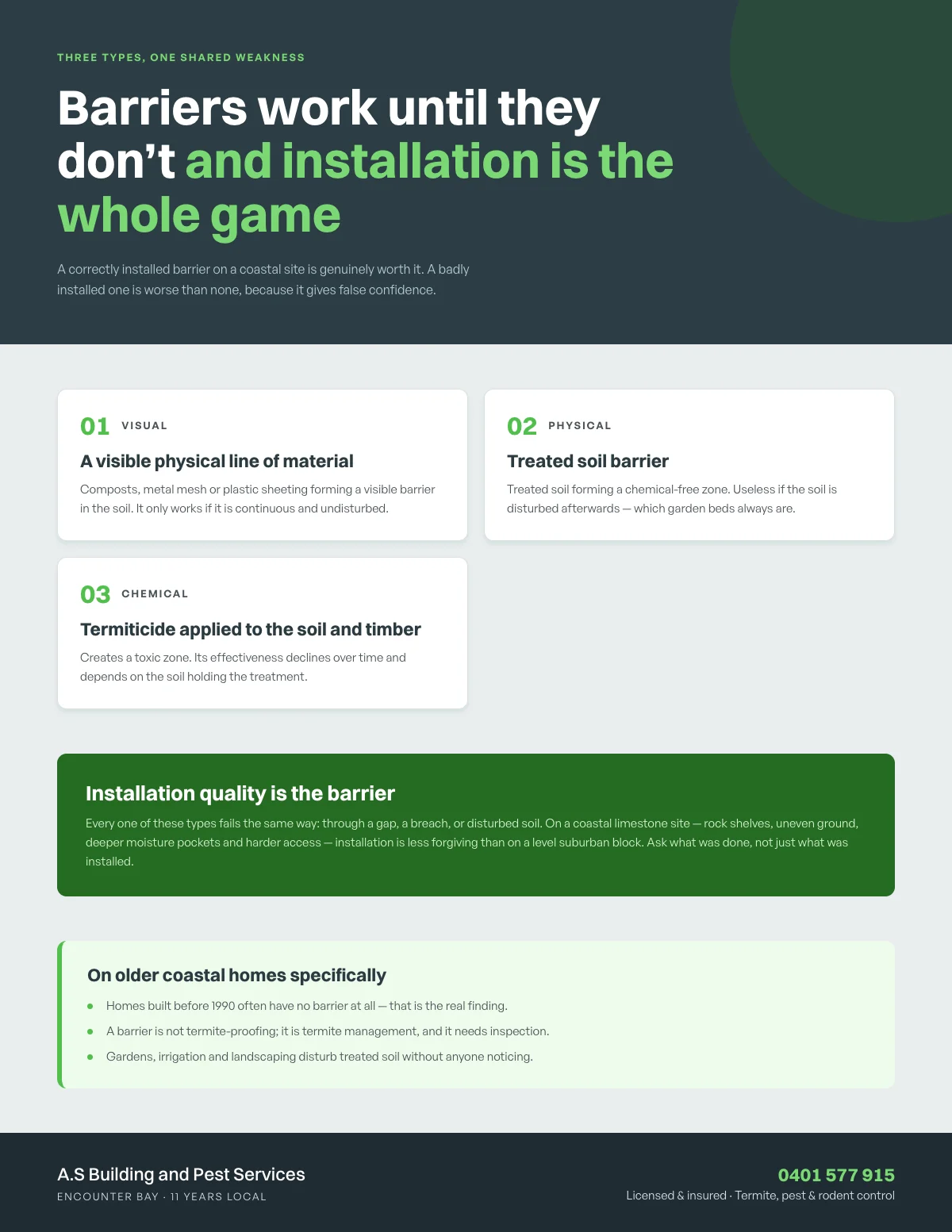
Was the perimeter complete? Barriers are continuous systems. A gap — around a downpipe, at a stump, at a wall junction, at a step in the slab — is a route. Installation quality is largely about continuity.
Is the barrier visible? Some systems are designed so you can see breaches. A visible system can be checked by a homeowner; an invisible one can’t.
Has anything changed since installation? This is the killer question. Barriers get defeated by ordinary building work: a new garden bed raised against the wall, a path or patio poured over the line, a downpipe relocated, an addition, a pergola post set inside the barrier line. Each of those creates a new pathway, and the barrier stops working in that area without anyone noticing.
Visual vs physical vs chemical
Visual barriers are sheets or strips that physically block the pathway and are designed so a breach is visible. The advantage is inspectability. The disadvantage is that anything buried or covered defeats the visual element, and visual systems need the ground level to stay where it was.
Physical barriers are continuous barriers of various materials installed into the ground. They’re less dependent on visibility and generally more robust, but harder to inspect for a breach.
Chemical barriers are treated soil. They’re effective while active and can be reinstalled, but they depend on the treated zone remaining undisturbed — so all the same modification problems apply, with the added factor that soil must not be disturbed for the system to remain intact.
Which is best on a coastal property? Genuinely, it depends on the property and what has happened on it. Rather than recommend a system from a blog post, the useful thing is to have the existing condition properly assessed — including whether there’s already a barrier, what type, and whether it’s still intact.
Why annual inspection still matters
Because a barrier isn’t a guarantee, and it has no way of telling you it has stopped working.
Regular inspection serves a different function:
- It finds live termites while they’re still a colony problem rather than a structural problem.
- It finds conducive conditions that have developed since installation — a new damp area, a downpipe that has started discharging against the wall, a garden bed raised against the line.
- It checks the barrier is still intact where the system is visible or checkable.
- It records what was found, which matters at sale time and for warranty purposes.
On older coastal homes this is the part that actually protects you. A barrier installed fifteen years ago tells you almost nothing about today unless someone has looked at it recently.
Homes built before 1990
🔒 No adoption date is stated in this draft. Industry practice changed substantially over the second half of the last century and a great many homes from that era went up with no termite barrier at all, but specific cut-off years for barrier adoption circulate widely and we haven’t verified one.
What can be said without a figure: if you can’t find documentation of a barrier on an older home, assume it doesn’t have one. Many homes built in that era have no barrier, or have had one installed later and poorly documented, or have had one partially defeated by later work.
For a buyer, that means the termite question on an older property isn’t “is the barrier working” but “is there a barrier, what type, and is it intact.” Those are three different questions and a report that answers only the first isn’t enough.
Whether a barrier is worth installing depends on the construction and the termite pressure — which is what an inspection establishes. Check how to tell if your home has termites first; the scope of what each inspection covers is in termite inspection versus building inspection. Our termite management covers the options across Victor Harbor. Get a quote before the next flight season.
Frequently asked questions
Do termite barriers work?
They work, within a defined limit. A termite barrier interrupts the pathway between the soil and the timber above it, which on a home with timber framing is a genuinely valuable protection. What it doesn’t do is stop termites travelling by other routes, protect timber already in contact with the ground, or protect a roof void. It’s one layer in a system that also depends on subfloor ventilation, moisture management and regular inspection — and on a property with no timber framing, it has nothing to protect.
Are termite barriers necessary?
For a home with timber framing, having one is better than not having one. For a home with no timber framing, there’s nothing for termites to eat and a barrier has nothing to do. The more useful question on an older coastal property isn’t whether a barrier is necessary in principle, but whether this property has one, what type it’s, and whether it’s still intact — because a barrier defeated by later building work doesn’t protect anything.
How do I know if my home has a termite barrier?
For an older home, the honest answer is that you often can’t tell by looking. A barrier is installed at or below ground level, and once a garden bed is raised against the wall, a path is poured, or a verandah is built over the perimeter, it’s buried and invisible. What you can usually do is look for documentation — a treatment or installation report, a warranty document, or a note in the strata minutes if the property is in a complex. Where that doesn’t exist, having the subfloor inspected is the way to establish whether there’s a barrier, what type it’s, and whether it’s still continuous. That’s a far more reliable answer than anything visible from the garden.
Adam Shaw — Owner
Licensed building and pest inspector with 11+ years of experience protecting Fleurieu Peninsula homes. Based in Encounter Bay, serving Victor Harbor, Goolwa, and surrounding areas.
More Helpful Articles
Explore our blog for practical guidance on building inspections, pest control, and property maintenance.
View All ArticlesNeed a Building or Pest Inspection?
Get your free quote today — thorough inspections, transparent pricing, and 11 years of local expertise.