Termite Inspection vs Building Inspection: What's the Difference?
What a termite inspection covers that a building inspection doesn't, the one visit that catches more than two — and when one is genuinely enough.
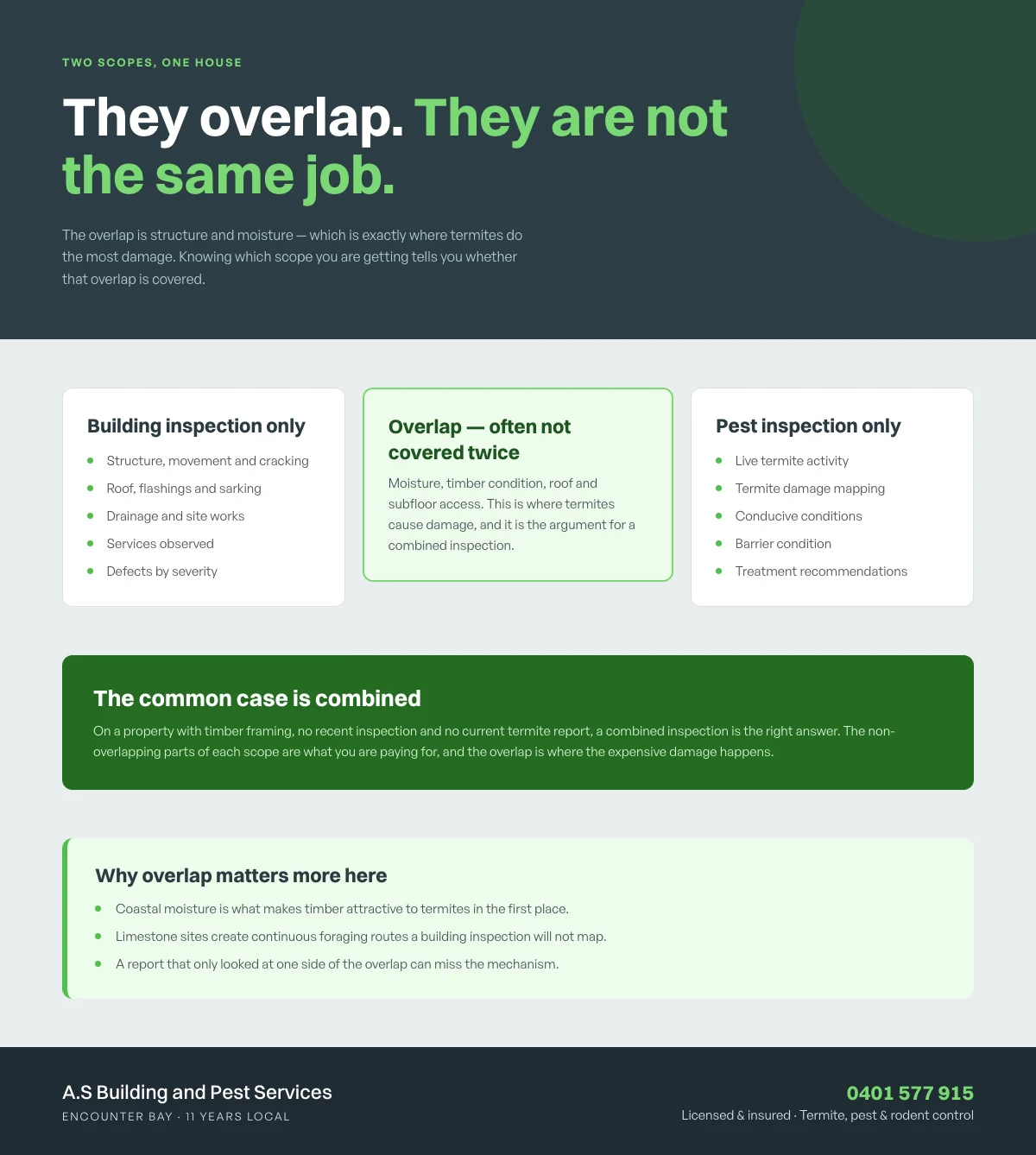
They’re two different scopes of work on the same property, looking at the same building from the same access points, and they’re reported separately.
Plenty of people assume one implies the other. It doesn’t. A building inspection isn’t a termite inspection, and knowing which one’s the difference between knowing and not knowing.
Termite inspection and building inspection: the two scopes side by side
| Building inspection | Termite inspection | |
|---|---|---|
| Looks at | Structure, fabric, defects | Timber and what lives in it |
| Key questions | Is it sound? Does water get in? | Are termites here? Was there damage? What invites them? |
| Roof void | Sarking, decay, insulation, framing | Termite damage, mud tubes, moisture, timber condition |
| Subfloor | Ground conditions, ventilation, decay, erosion | Termite pathways, damage, conducive conditions, barrier presence |
| Live termites | Not assessed | Directly assessed and reported |
| Structural cracking | Assessed | Not its scope |
| Roof covering, gutters, walls | Assessed | Only where relevant to timber or moisture |
| What it tells you | Whether the building is sound | Whether the timber is being eaten, and what invites it |
What a combined inspection catches that two separate ones miss
This is the argument, and it’s a real one rather than a sales convenience.
The same defect, read twice. Water entry into a roof void is a building inspection finding. The moisture that caused it, and the conditions it created in timber you can’t see, are a termite inspection finding. Done separately, both are reported in isolation and neither report explains the other.
Activity paths get followed. Termites travel from ground level, through voids, along pipes and cables, and into the roof. An inspector assessing structure and pest risk in the same visit can follow a pathway end to end. Two inspectors working separately may each stop where their scope ends.
Causes and consequences get connected. Subfloor ventilation, ground moisture and drainage affect both building durability and termite risk. The subfloor is the single most informative space on most coastal properties, and it belongs to both scopes.
One visit, one set of access arrangements. Getting into a subfloor is the hard part. It’s arranged once rather than twice, which in practice is also usually cheaper and faster.
One report to read. Two reports means twice the reading, two sets of severities to reconcile, and a higher chance that something significant sits in the document nobody reads carefully.
What it’s not: a combined inspection isn’t automatically better because one inspector does both. If you want genuinely independent assessment of a significant structural concern, that’s an engineer’s question, not an inspector’s — and no combination of building and pest scopes changes it.
Why one inspector may still mean two reports
Even with one visit, the scopes stay separate, and you should expect two documents or two clearly separated sections.
The reasoning is sound. Building defects and timber-pest findings have different severity scales, different follow-up, and different implications. A structural crack and a termite mud tube aren’t the same kind of finding and shouldn’t be ranked on the same scale.
So the commercial benefit of combining is coordination, access and efficiency — not a single merged verdict. If someone offers you “one report” as though the two scopes had been merged into one judgement, be slightly suspicious of what has actually been left out.
Cost and timing
Cost. Two separate inspections involve two fees, two travel arrangements and two mobilisations. A combined inspection is generally cheaper than the two separately — though not invariably, since it depends on the property and the provider. Treat “always cheaper” as a sales line rather than a fact.
Timing. One visit instead of two means the property is opened once. On a property that’s vacant, tenanted, or being prepared for settlement, that matters — fewer access windows, less coordination, fewer chances for something to go wrong between visits.
When a single scope is genuinely enough. If the property has no timber framing at all — a concrete slab unit, for example — there’s nothing for termites to eat. If you’re buying a property that already has a current termite report with documented barrier status, and nothing has changed since, that may satisfy the pest question. Rare, but real.
When you need both. Anything with timber framing, which on the Fleurieu is most older housing stock. And where the building is old enough that the timber and the fabric may both be deteriorating at once.
How to book both
Ask for a combined building and pest inspection, and check three things:
That both scopes are in writing. Not “we do pest inspections” — that the building and pest scopes are both covered, with the areas listed.
That the pest inspection reports on the three things separately — live termites, existing damage, and conducive conditions. A pest section that only says “no termites observed” is much weaker than one that reports all three, because the conducive conditions section is what tells you about the future.
That access includes the subfloor and roof void. If those can’t be entered, you aren’t getting the inspection that matters.
The scope question matters on the Fleurieu, where termite pressure and coastal defects run together: see whether home inspectors check for pests. A combined building and pest inspection is the default here — and for the buyer’s side, the nine-defect checklist is in buying a coastal home in SA. Get a quote for the property you’re considering.
Frequently asked questions
Do I need both inspections?
If the property has timber framing, yes — and on most older homes around Victor Harbor, Port Elliot and Goolwa it does. A building inspection assesses the structure and fabric; a termite inspection assesses the timber and what’s living in or attacking it. Neither covers the other. The strongest reason for both is that they read the same spaces differently: water entry found by a building inspection is also a termite risk factor, and the subfloor conditions that affect structural durability are the same conditions that make a property attractive to termites. If the property has no timber framing, or a current termite report already documents condition and barrier status with nothing changed since, one may be enough.
Is a combined building and pest inspection worth it?
On an older property with timber framing, generally yes. You get both scopes in one visit, the subfloor and roof void only need arranging once, and the two sets of findings get read together — which is the part that matters, because a water problem and the termite risk it creates are usually connected. Treat it as one coordinated visit rather than a single merged verdict, though. The two scopes are still reported separately, and if you want an independent opinion on a significant structural concern, that’s an engineer’s assessment regardless of what the inspector does.
Adam Shaw — Owner
Licensed building and pest inspector with 11+ years of experience protecting Fleurieu Peninsula homes. Based in Encounter Bay, serving Victor Harbor, Goolwa, and surrounding areas.
More Helpful Articles
Explore our blog for practical guidance on building inspections, pest control, and property maintenance.
View All ArticlesNeed a Building or Pest Inspection?
Get your free quote today — thorough inspections, transparent pricing, and 11 years of local expertise.