7 Signs of Termites in Your Home — and the One You Can't See
Seven visible signs of termites in your home, plus the hidden one. Why Fleurieu homes are higher risk, and what to do if you find them.
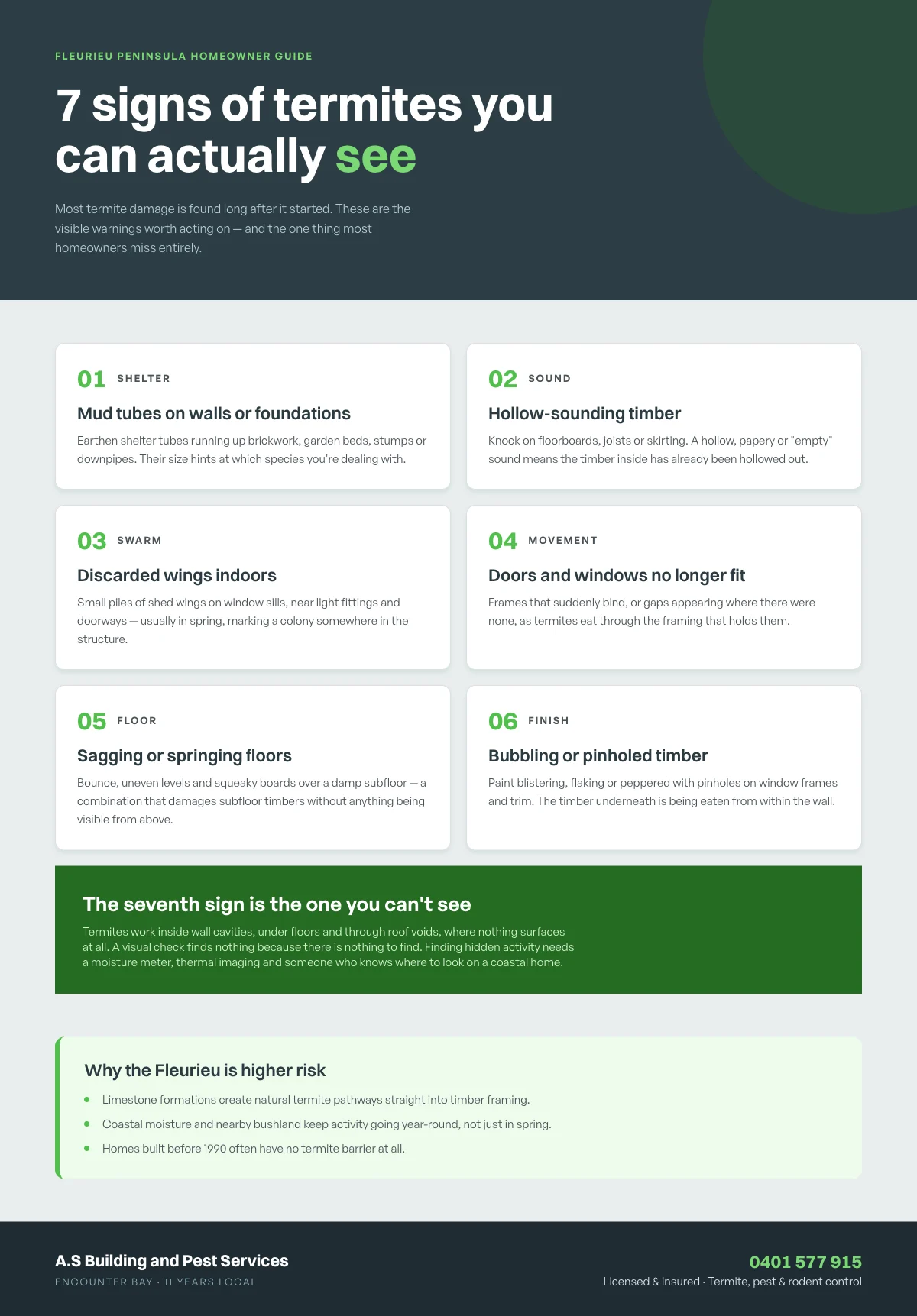
Most homeowners who have termites don’t know it for years. There’s no reliable way to spot an infestation from the front lawn, and by the time a floor visibly sags, the damage underneath is usually years old. What you can do is learn the handful of signs termites leave behind — and be honest about the one that matters most, because it leaves no sign at all.
If you want the short version, here it’s.
The 7 visible signs of termites
These are the signs worth knowing. Most are found during normal life in a home, not during an inspection.
1. Mud tubes on walls, foundations or stumps
Termites build earthen shelter tubes to stay protected while they travel. You’ll see these as thin mud “snakes” running up brickwork, along foundations, around garden beds, or across firewood and stumps.
Fresh tubes look different from old ones — soft and dark on the inside, where dried-out tubes crumble. A tube that appears over a single night is a strong reason to get it looked at properly.
2. Timber that sounds hollow when you knock on it
Tap your floorboards, skirting boards and door frames. Healthy timber gives a dull, solid thud. Termite-eaten timber gives a hollow, papery or empty sound, because the inside has been eaten out while the surface still looks fine.
This is the single most useful thing a homeowner can do, and it costs nothing.
3. Discarded wings near windows and doorways
When a termite colony swarms, winged reproductives leave, mate, shed their wings and die. Inside a home that means small piles of pale, discarded wings on window sills, near light fittings, or in doorways. Swarmers usually appear in warmer months in this region.
Finding wings doesn’t prove an active colony nearby — they travel a long way — but it means inspecting properly is worth doing.
4. Doors and windows that suddenly stop fitting
A door that used to swing freely now catches on the frame. A window needs a shove to close. That’s often the framing behind the opening being eaten out.
5. Floors that bounce, sag or squeak
Soft, springy boards, uneven floors between rooms, and squeaking over a damp area usually mean subfloor timbers have been damaged. You may not see anything at all from inside the room — the damage is underneath.
6. Bubbling, flaking or pinholed paint on timber
Paint on window frames and trim that blisters, peels or is peppered with tiny holes is a classic sign. The timber underneath is being consumed from inside the wall, and the paint is failing where the wall behind it has been hollowed out.
7. Timber that’s visibly damaged, blistered or crumbling
Where termites have worked on a timber surface long enough, the surface itself breaks down — it looks furry, blistered, or crumbles when you press it.
The 8th sign is the one you can’t see
Here’s the part most people find uncomfortable: the most reliable sign of termites is the absence of any visible sign.
Termites do most of their work inside wall cavities, beneath floors, and inside roof voids, where nothing surfaces at all. A homeowner walking through a house can look at every room, find nothing that looks wrong, and still have an active infestation eating the structure from within.
That’s not a failure of attention. It’s how termites work. Finding hidden activity takes a moisture meter, thermal imaging, and someone trained to know where to look on a coastal property.
If your checks so far have turned up mud tubes, hollow-sounding timber or wings, You’ve a reason to act. If they have turned up nothing, you don’t have a reason to relax.
Why Fleurieu homes are at higher risk
Three things make this part of South Australia harder than inland areas.
Limestone creates natural pathways. Limestone formations run under parts of the Peninsula and break down into soil, which gives subterranean termites a direct route into timber framing — under and around a building.
Coastal moisture doesn’t stop. Termite activity is tied to warmth and moisture. A mild coastal climate with reliable rainfall means activity can continue year-round rather than concentrating into a short spring window.
Many older homes have no barrier at all. Australian building practice changed a great deal over the second half of the last century, and a lot of homes from that era went up with no termite barrier system at all. For those houses, the timber is the only protection.
If any of these signs are present, the next step is professional confirmation, not DIY treatment — the scope difference is covered in termite inspection versus building inspection. We run termite inspections and management across Victor Harbor and the Fleurieu. Get a quote the day you find the mud trail.
What to do if you find signs
Do:
- Photograph it, and note the date and exact location
- Keep the area undisturbed
- Arrange an inspection that covers both buildings and timber pests
Don’t:
- Spray, seal or inject anything yourself
- Cut into or remove the mud tubes — you can disperse a colony and make it harder to treat
- Disturb timber you’re suspecting of damage
Nothing you find from inside a home is enough to decide what’s happening. Signs tell you a professional inspection is worth having. They don’t tell you what treatment is needed.
What you can and can’t do yourself
Reasonable DIY: tapping your own floorboards, looking for wings and tubes, keeping firewood and stacked timber away from the house, fixing dripping taps, and clearing vegetation off walls.
Not DIY: anything involving chemicals, drilling, sealing or removing timber. That needs someone who knows which species you’re dealing with, where the colony is, and which method will actually reach it.
Frequently asked questions
How can you tell if You’ve termites?
Look for the signs above — mud tubes, hollow-sounding timber, discarded wings, doors and windows binding, sagging floors, and bubbling paint on timber. But most active infestations show no visible sign at all, which is why a home that looks fine isn’t proof of a termite-free home.
Do termites mean my house is unsafe?
Not automatically. Termites affect timber framing and can weaken subfloor and roof structures over time, which matters in a house. Severity depends on the species involved, the extent of the activity, and how long it has been going on. An inspection establishes which of those applies.
How often should I check for termites?
Annually is the standard advice for this region, and consistency matters more than frequency. Properties with a known history, heavy surrounding vegetation or direct coastal exposure deserve more regular attention than the once-a-year minimum.
Are termites more common near the coast?
Generally, yes. Coastal areas tend to have the combination of moisture and mild temperatures that subterranean termites need to stay active year-round, and this region also has limestone formations that make access to timber framing easier.
Every question and answer below is verbatim identical to the visible FAQ above. Don’t edit one without the other.
Adam Shaw — Owner
Licensed building and pest inspector with 11+ years of experience protecting Fleurieu Peninsula homes. Based in Encounter Bay, serving Victor Harbor, Goolwa, and surrounding areas.
More Helpful Articles
Explore our blog for practical guidance on building inspections, pest control, and property maintenance.
View All ArticlesNeed a Building or Pest Inspection?
Get your free quote today — thorough inspections, transparent pricing, and 11 years of local expertise.