Buying a Coastal Home in SA: 9 Defects to Check Before You Offer
Buying a coastal home in South Australia? The nine defects to check before you offer, how to spot each from outside the property, and when to walk away.
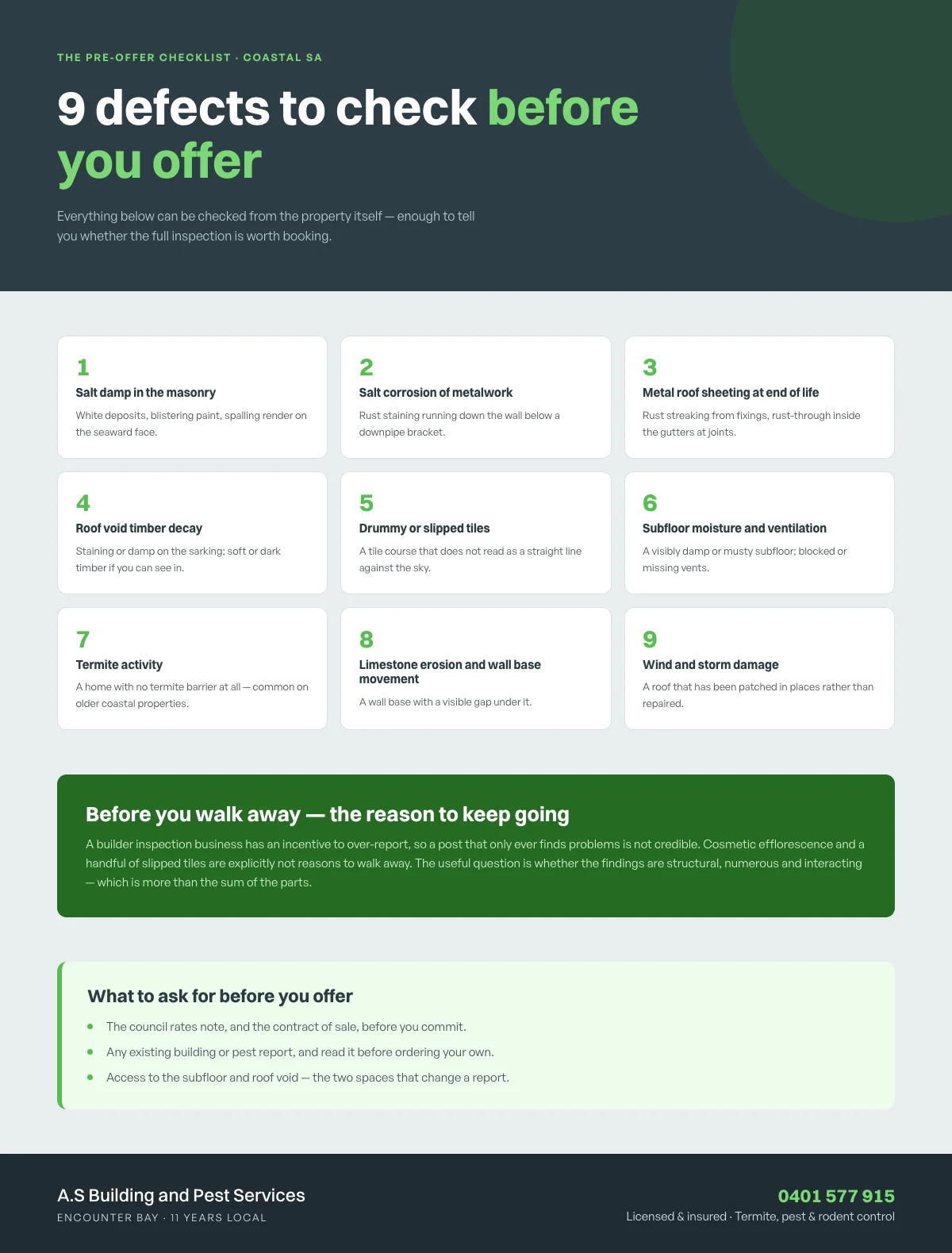
Coastal properties fail in ways inland properties don’t, and almost all of it comes down to the same three things: salt, wind and water finding a way in. None of the defects below are exotic. On an older home near the coast they’re simply what you should expect to find, which is exactly why they should be checked for deliberately before you make an offer. These are the nine we look for on every pre-purchase inspection near the water.
This is the pre-offer list. A proper coastal home inspection should cover all of this using instruments and safe access — but everything below can be looked at from the property itself, and that’s enough to tell you whether buying the inspection is the right call. Each defect links to a full explanation of what to look for.
The nine a coastal home inspection should find
1. Salt damp in the masonry
White powder, blistering paint, spalling render on the walls most exposed to the sea. The one to watch: white deposits and crumbling render on the seaward face.
2. Salt corrosion of gutters, downpipes and tie-downs
Metalwork corroding faster than it should, staining the walls below it. The one to watch: rust staining running down the wall below a downpipe bracket.
3. Metal roof sheeting at the end of its life
Coating loss and rust on the roof itself, progressing toward perforation. The one to watch: rust streaking down the roof from fixings, and rust-through inside the gutters at the joints.
4. Roof void timber decay
Water getting in through slipped or cracked tiles and rotting the structure above your ceiling. The one to watch: staining or damp on the sarking, and soft or dark timber if you can see into the roof space.
5. Drummy or slipped tiles
Cracked and slipped tiles letting wind-driven rain in. The one to watch: a tile course that doesn’t read as a straight line against the sky.
6. Subfloor moisture and poor ventilation
A damp subfloor, blocked vents, timbers in contact with soil, or stored material sitting under the floor. The one to watch: a visibly damp or musty subfloor, and blocked or missing vents.
7. Termite activity
Mud tubes, hollow-sounding timber, winged termites near openings. The one to watch: a home with no termite barrier at all, which is common on older coastal properties.
8. Limestone foundation erosion and wall base movement
Cracking that doesn’t match the building’s age, doors binding on one side, and corrosion on exposed tie-downs where the ground has dropped away from the wall base. The one to watch: a wall base with a visible gap under it.
9. Wind and storm damage
Blown or lifted roofing, damaged fascias and eaves, and debris damage. The one to watch: a roof that has been patched in places rather than repaired.
How to spot each from outside
Everything on that list can be checked from the property boundary. You don’t need access, you don’t need to go on the roof, and you don’t need a damp meter. What you can’t do from the street is judge how bad any of it’s — that’s what the inspection is for. This list tells you whether to buy the inspection.
Look at the walls first. Spalling render, white bloom, blistering paint, rust staining below metalwork, and efflorescence clustered around openings. Note which elevations it’s on — if it’s worse on the seaward face, that’s consistent with salt exposure rather than a one-off.
Look at the wall base. Run your eye along the bottom of the walls where they meet the ground. A gap between brickwork and soil, a wall base sitting proud of the ground, staining along the base, and rusted tie-downs or brackets are all visible in about ten seconds.
Look up at the roof. From the street or the nature strip, check the tile or sheeting line against the sky for slipped tiles, sagging, or patched areas. Check the ridge line for movement. Check the gutters for rust-through, staining, and debris.
Look at the ground. Does the land slope toward the house? Is a downpipe discharging next to a wall? Is a garden bed raised against the brickwork? Has a path or patio been poured above the original ground level? All of these are ground-level water problems you can see.
Listen and look at the roof line. Drummy tiles announce themselves.
What to ask for before you offer
Six questions, asked before you commit rather than after:
- “Has the building ever been inspected, and can I see the report?” A previous report is information, not a guarantee — but it’s something to work from.
- “What has been done to the roof, and when?” Patches, re-fixing and re-bedding all point to a roof that has had ongoing problems rather than one that was fixed once, properly.
- “When were the gutters and downpipes last replaced or repaired?” Corroded metalwork tells you about water management at the wall base as much as about the metal.
- “Has the wall base, render or brickwork been repointed or rendered before, and what was it done with?” On a coastal property, what a previous repair was made from often matters more than that it happened.
- “Is there a termite barrier, and is there documentation?” If there’s no barrier on an older coastal home, that’s worth knowing before you buy rather than after.
- “How long has it been vacant, and has anything been left open or closed up?” Vacancy changes ventilation and moisture, and it changes what you inherit in the roof space and subfloor.
Also ask for the council rates note and any building approvals on file. A property that has been substantially altered — especially at the wall base or roof — has a history, and the approvals record is part of that history.
When to walk away
Some things are a negotiation. A few aren’t.
Reason to keep going: cosmetic efflorescence on an otherwise sound wall. A roof with a handful of slipped tiles and no water entry inside. An old wall base with a corroded bracket that’s addressable. Metalwork partway through its corrosion life with the drainage still working.
Reason to slow down and think: active water entry through the roof with staining on the structural timber. Corrosion that has reached the tie-downs. A wall base that has dropped away from the framing. Salt damage deep enough that the brick itself is spalling, because that’s expensive and it recurs if the water source isn’t fixed.
Reason to walk away: a seller who won’t let you inspect, or who resists access to the subfloor or roof space. A significant structural crack with no plausible cause and no history explaining it. Termite activity that has clearly been active and been ignored. Any of those means the information you need isn’t available, and buying without it’s gambling rather than negotiating.
The most common mistake isn’t walking away when you should. It’s the seller who says the building is “solid as a rock” and the buyer who believes it because it’s easier than commissioning an inspection. On an older coastal property, “looks great” and “structurally sound” are two completely different claims, and only one of them has been checked.
A defect list is only useful before you commit. A pre-purchase building and pest inspection checks all nine of these in one visit across Victor Harbor and the Fleurieu — the two most common, salt damp and salt corrosion, are covered in their own guides. Get a quote before you make the offer, not after.
Frequently asked questions
What should I check when buying a coastal property?
Start with water. Check where water is going — roof condition and drainage, the wall base and what the ground is doing against it, ventilation in the subfloor, and any staining inside. Then check salt on the walls and any metalwork. Then check termites, particularly whether a barrier exists. On a coastal property these are the defects that recur, because the conditions that cause them are still in place. The full list is above, and each defect links to a detailed explanation of what to look for.
Is buying a house near the sea more expensive to maintain?
It can be, and the reason is specific rather than general. Coastal conditions don’t just age a building faster, they attack particular materials — salt-affected masonry and metalwork, and roofs under constant wind — and each of those needs to be dealt with before it becomes a structural problem. What matters for a buyer isn’t a general maintenance premium but whether the previous owner maintained what they had, and whether the expensive defects are already done or still ahead of you.
Should I get an inspection before or after I make an offer?
Before, if at all possible, and it’s worth making the offer conditional on one. An inspection after You’ve committed turns a negotiation into a problem. Doing it first means the findings are information you can price, decline on, or walk away from — which is a far better position than negotiating a price reduction for a problem you can’t walk back from.
Schema
RESOLVED — all nine defects are now listed. The draft previously declared
numberOfItems: 9while itsitemListElementarray held only eight entries. That’s invalid structured data and search engines may discard the entire block.The cause was over-caution: defect 9 (wind and storm damage) has no deep-dive post, and the first fix treated the missing
urlas disqualifying and dropped the entry entirely — while leavingnumberOfItemsat 9, which is worse than the original bug.A
ListItemdoesn’t require aurl. Per schema.org, the only required properties are@typeandposition;urlis strongly recommended, not mandatory. Item 9 therefore appears with its position and name and nourl. All nine are now present andnumberOfItemscorrectly reads 9.The better fix, if one is available: a wind-and-storm-damage article would make a strong Day 31 and would let item 9 carry a real URL. Until then the array is complete and valid.
Adam Shaw — Owner
Licensed building and pest inspector with 11+ years of experience protecting Fleurieu Peninsula homes. Based in Encounter Bay, serving Victor Harbor, Goolwa, and surrounding areas.
More Helpful Articles
Explore our blog for practical guidance on building inspections, pest control, and property maintenance.
View All ArticlesNeed a Building or Pest Inspection?
Get your free quote today — thorough inspections, transparent pricing, and 11 years of local expertise.