Salt Corrosion: How Sea Air Damages Roofs, Gutters and Steel
Salt corrosion on coastal Fleurieu homes — how sea air breaks down metal roofing, gutters and tie-downs, and what to check before you buy.
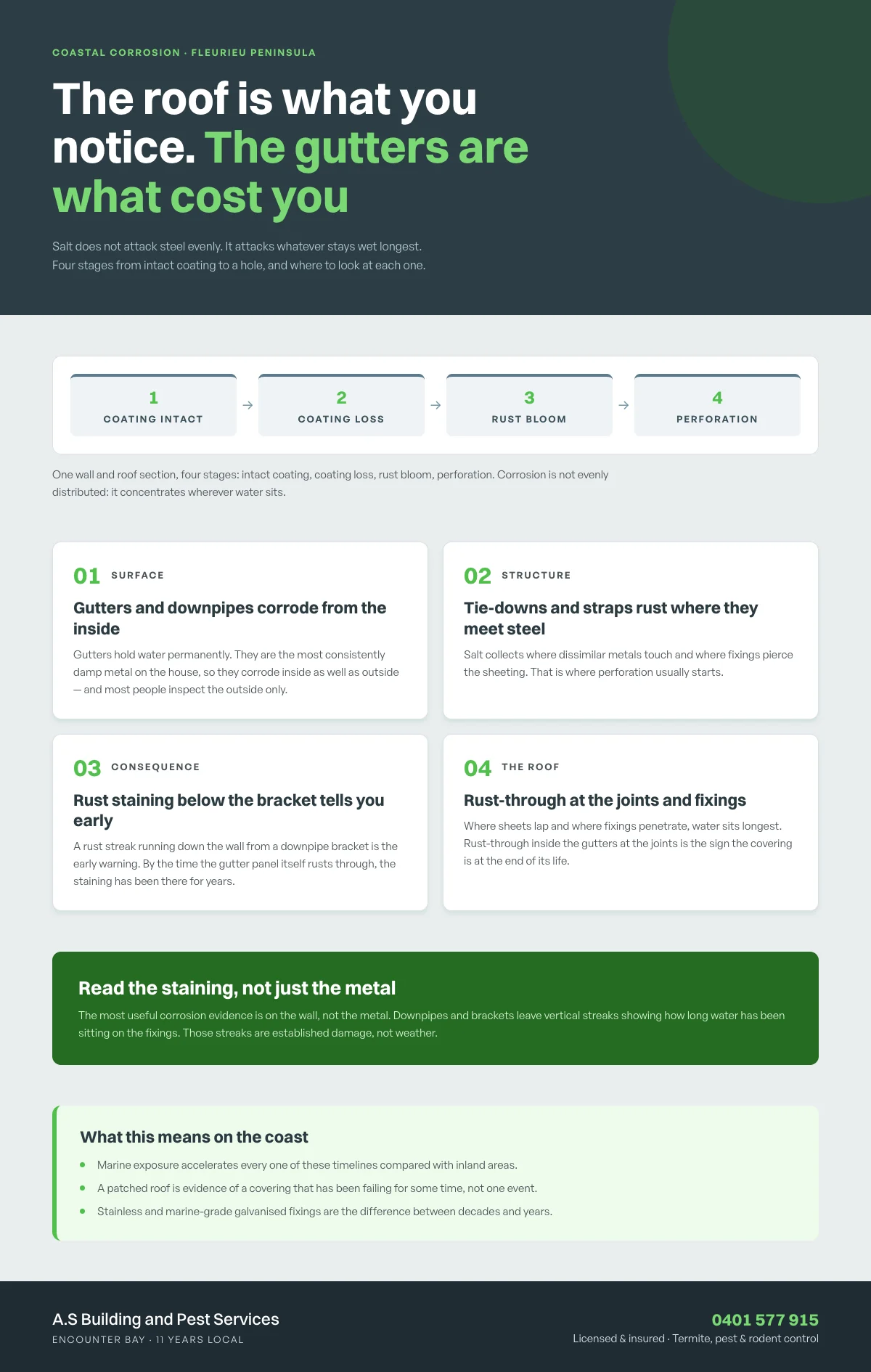
Every metal roof within sight of the coast is on a clock, and the clock is driven by something most people don’t connect to roof condition: the salt in the air. A metal roof that would last indefinitely inland can go from coated to perforated in a fraction of that time within a few kilometres of the shoreline.
On the Fleurieu this isn’t a rare edge case. It’s the normal condition of metalwork on most older homes, and it’s the reason a coastal buyer needs to look very carefully at metal. We check metalwork closely on every coastal inspection — roofs, gutters, tie-downs — because that’s where the salt gets in first.
Why salt corrosion is faster near the sea
Two things combine. Salt carried in sea spray settles on every exposed metal surface, and salt is hygroscopic — it draws moisture out of the air and holds a film of it against the metal.
That matters because corrosion needs three things to start: the metal surface, moisture, and an electrolyte to carry current between them. Salt provides all three at once. Inland, a metal surface gets moisture occasionally and dries again. Near the coast it stays damp, and the film stays conductive, and the corrosion process simply keeps running.
This is why damage appears first where water sits and salt collects — valleys, laps, fasteners, low points and anything that shelters a wet surface.
The sequence
It happens in a recognisable order, and knowing it helps because the early stages are visible from the ground.
Coating loss. The protective coating breaks down first. On Colorbond and similar steel sheeting this shows as chalking, fading or bare metal appearing at edges and fixings.
Rust bloom. The bare metal corrodes and produces the familiar orange staining. On a roof this appears as rust streaks running down from fixings and valleys, and on a wall as staining below downpipe brackets and anchors.
Perforation. Once the section has lost enough material, it perforates. This is the point where the roof stops shedding water and starts admitting it, and it’s usually where the problem becomes expensive — because water entering the roof space drives damp and timber decay on everything below.
The gap between stage one and stage three is usually the useful window. A roof showing coating loss and early rust is a maintenance problem. A roof showing perforation is a water problem.
What it does to the rest of the metalwork
The roof sheeting is the part people notice. It’s often not the part that matters most.
Gutters and downpipes. Gutters hold water permanently. They’re the most consistently damp metal on the house, so they corrode from the inside as well as the outside, often without any external sign. A gutter can look sound and fail at the joint.
Downpipes and brackets. These corrode and then stain the wall below them — which is often how salt corrosion gets reported as a wall defect when it’s really a metalwork one.
Tie-downs and anchors. These are the serious case. Tie-down rods and anchor bolts that corrode can be concealed inside the wall cavity, and a corroded tie-down at the wall base on a limestone site loses section over time. Corrosion progressing far enough can go unseen from inside the house.
Flashings and valleys. Where different metals meet, or where a lap sits, is where coating fails first and where perforation starts.
What a coastal buyer should check on an older metal roof
From the ground, before you offer:
- Rust streaking below fixings and valleys. Where and how much. Streaks running a long way down the roof suggest it has been active for some time.
- Bare or chalking metal at laps and edges. Early coating loss.
- Rust staining on the wall below downpipes and brackets. Often the first sign anyone notices.
- Sagging or deflection in the sheeting. Can follow from corroded fasteners.
- Gutters that look sound from outside. Ask whether they have been replaced or repaired, and look inside for rust-through at the joints.
- Ceiling stains or damp in the roof space. The consequence of stage three, and the reason any of the above matters.
Inside the roof void, the question is whether water is getting in and what it has done to the timber it lands on.
Prevention versus repair
This is a distinction worth making early, because it determines how much a buyer should be adjusting for.
Prevention is stopping new corrosion. It means washing salt off metal surfaces, replacing fasteners and fixings before they fail rather than after, keeping gutters clear and draining, and repairing the small coating failures that become holes later.
Repair is dealing with metal that has already been consumed. That means replacing corroded sheeting, sections of gutter, corroded tie-downs or flashings — and critically, assessing whether the timber underneath the roof has been damaged by the water that got in first.
Which one you’re dealing with changes the cost completely. A roof at the coating-loss stage is a maintenance item. A roof with perforation and historic water entry into the roof space is a structural item that needs looking at properly before anyone commits.
The masonry half of the same sea air is salt damp in coastal homes — the salt that reaches walls rather than metal. If your roof, gutters or fixings are showing these signs, a combined building and pest inspection maps what’s cosmetic and what needs action across Victor Harbor and the Fleurieu. Get a quote before the next wet season.
Frequently asked questions
Do metal roofs rust near the sea?
Yes, faster than inland. Salt in the air settles on metal and holds moisture against it, and that combination is what drives corrosion. The sea isn’t the only factor — where water can sit and how long the metal stays wet matter too — but two roofs of the same age and material can behave very differently a few kilometres apart because of exposure alone.
How do I know if a metal roof is leaking or just rusting?
Rusting and leaking are different problems at different stages. Rust streaking below fixings, chalking and bare metal mean corrosion is happening but the roof may still be shedding water. Leaking shows up as damp or staining inside, in the roof space or on ceilings, or as water tracks below fixings during or after rain. If you’re seeing water inside, the roof is admitting water and the timber underneath needs assessing.
Should I replace a rusted metal roof or repair it?
It depends which stage the corrosion has reached, which is why it should be assessed rather than judged from the ground. Surface corrosion at fixings and laps may be a repair or maintenance matter. Perforated sheeting, corroded tie-downs, or any sign water has entered the roof space is a different and more serious situation, and the timber damage needs looking at before the roof is quoted. An inspection establishes which of these applies.
Adam Shaw — Owner
Licensed building and pest inspector with 11+ years of experience protecting Fleurieu Peninsula homes. Based in Encounter Bay, serving Victor Harbor, Goolwa, and surrounding areas.
More Helpful Articles
Explore our blog for practical guidance on building inspections, pest control, and property maintenance.
View All ArticlesNeed a Building or Pest Inspection?
Get your free quote today — thorough inspections, transparent pricing, and 11 years of local expertise.