Salt Damp in Coastal Homes: Causes, Signs and What to Do
Salt damp in coastal Fleurieu homes — what it actually is, the five signs to look for, why painting over it fails, and what an inspector checks underneath.
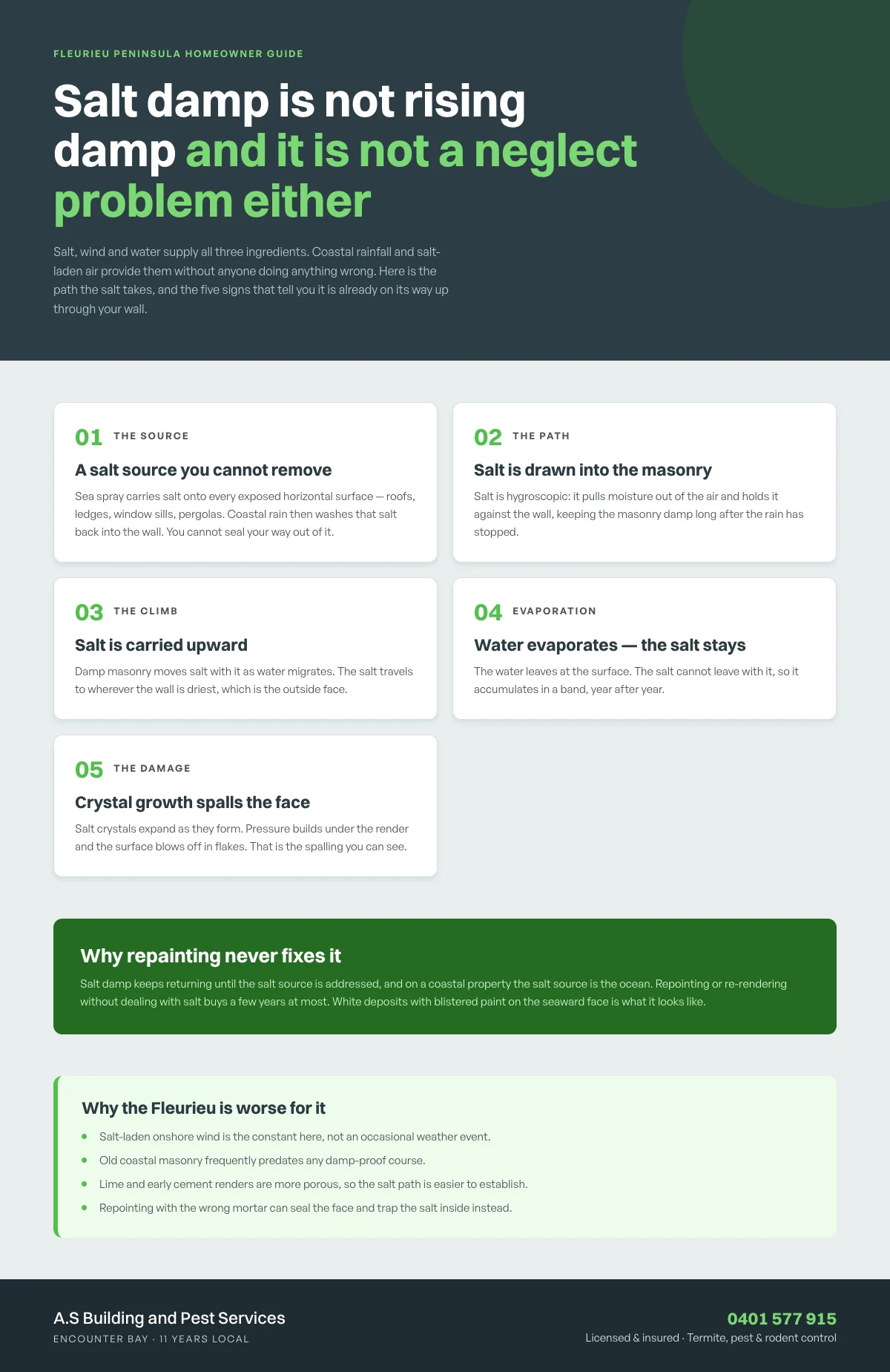
Salt damp is the most misdiagnosed defect on the Fleurieu Peninsula. It gets mistaken for ordinary damp, it gets painted over, and a year later the same patch is back and the wall is worse than before. It’s also the defect most homeowners assume is just how a coastal house looks.
It’s not. Salt damp is a specific mechanism with specific signs, and once you know what you’re looking at, you can tell whether a wall has a surface problem or a real one. We see it on older coastal homes right across the Peninsula — most often after someone has already painted over it once.
What salt damp actually is
Salt damp is what happens when salt-laden moisture is drawn into porous masonry — brick, block, render, stone — and then evaporates at the surface.
Here’s why that’s destructive rather than cosmetic. The water carries dissolved salts with it. When the water reaches the surface and evaporates, the salt is left behind and crystallises. Those crystals grow inside the pores of the material, and as they grow they push the surrounding brick, render or stone apart from within.
So the visible white powder or the flaking render is the end of the process, not the beginning. By the time it’s on the surface, the material underneath has already been working for some time. That’s the single most important thing to understand about this defect, and it’s why it keeps coming back when it’s treated as a surface problem.
The five visible signs
1. White powder or crystal deposits on the surface
Fine white bloom on brickwork, block or render, often strongest where water has had time to wick through and dry. This is the salt itself, crystallising out.
2. Blistering, flaking or peeling paint
Paint that lifts away in sheets or bubbles, usually over render or masonry. The paint isn’t failing on its own — moisture is coming through the wall from behind and pushing the film off.
3. Crumbling or powdery render
Render that has gone soft, pitted or friable, and that crumbles under light pressure. At this stage the surface material has been consumed. This is serious rather than cosmetic.
4. Rust staining or corrosion streaks
Brown streaks below fixings, anchors, downpipe brackets or tie-downs. The rust is the visible trace of water moving through the wall and corroding metalwork on the way.
5. Efflorescence around openings and joints
White deposits clustered around windows, doors, vents or wall-to-wall junctions — the places water concentrates and evaporates fastest.
Why coastal homes get it
Two things have to be true for salt damp, and the coast supplies both.
A salt source. Sea spray carries salt onto every exposed horizontal surface — roofs, ledges, window sills, pergolas. Rainwater then washes that salt into the wall. Coastal rainfall means that wash-in happens reliably rather than occasionally.
A way for water to move through the material. Salt can only travel through a wall if the wall is porous and the water has a route in. Older masonry on this Peninsula is frequently porous, and old render is frequently cracked somewhere you can’t see.
Add proximity to the coast for constant airborne salt and wind-driven rain, and the conditions for this defect are present on most older homes near Granite Island, The Bluff and Rosetta Head from the day they’re built.
Why painting over it doesn’t work
This is the most common mistake we see, and it’s worth understanding why it fails rather than just avoiding it.
The salt is still in the wall. Painting the surface seals the pores, which stops the water evaporating through the face of the wall. The moisture has to go somewhere, so it stays in the material and the salts crystallise deeper. The wall then spalls from behind the new paint, taking the coating with it.
The result is usually worse than before: You’ve lost sound render, You’ve spent money on painting, and the underlying problem is unchanged. Sealing a wall with salt in it doesn’t fix it — it removes the mechanism the wall was using to release the moisture, which forces more damage into the wall.
The same logic applies to tiling over a damp wall, and to rendering over render without drying the original first.
What an inspector looks for underneath
The surface signs are the easy part. The point of an inspection is finding out why the salt is there, because that determines whether it’s a small fix or a structural one.
An inspector is checking whether the moisture source is still active — failed drainage, a leaking downpipe, a blocked gutter discharging against the wall, missing roof tiles, or ground that has settled and opened the wall base. Then whether the wall can still dry: are the weepholes clear, is the wall base holding, is there anything trapping moisture against it.
Then the substrate. Where render has come away, what’s behind it matters — is the brick sound, or spalling too? And where metalwork is showing rust staining, whether the corrosion has progressed into structural fixings.
That’s the question a professional inspection answers. A combined building and pest inspection checks the moisture source, the wall’s ability to dry and the substrate behind the render — the same checks we run across Victor Harbor and the surrounding Fleurieu coast. If a wall like this is making you second-guess a purchase or a repaint, get a quote before you commit to either.
Frequently asked questions
Can salt damp be fixed?
Yes, but the surface deposit isn’t the problem. It’s what’s left behind when moisture carrying salt dries out of the wall. Fixing it means finding and stopping the moisture getting in, letting the wall dry out properly, and then repairing the surface materials that were damaged. Until the moisture source is dealt with, any surface repair will fail again — usually sooner than the first one.
Is salt damp dangerous for my house?
It’s a genuine defect rather than a cosmetic one, because it destroys the material it appears on. Left long enough it removes brick and render from the wall, and where the wall base is affected it can expose the framing and metalwork above it. The severity depends on how long it has been active and how much of the wall is affected, which is what an inspection establishes.
Can I paint over salt damp to make it look better?
Painting over it usually makes the underlying damage worse. The salt is still in the wall, and sealing the surface traps the moisture behind the coating, so the wall spalls from inside and takes the new paint with it. It also removes the visible evidence, which makes the problem harder to monitor. The visible symptom is the only warning you get — worth keeping until the cause is dealt with.
Adam Shaw — Owner
Licensed building and pest inspector with 11+ years of experience protecting Fleurieu Peninsula homes. Based in Encounter Bay, serving Victor Harbor, Goolwa, and surrounding areas.
More Helpful Articles
Explore our blog for practical guidance on building inspections, pest control, and property maintenance.
View All ArticlesNeed a Building or Pest Inspection?
Get your free quote today — thorough inspections, transparent pricing, and 11 years of local expertise.