Rising Damp vs Salt Damp: How to Tell Them Apart
Rising damp or salt damp? How to tell them apart with the tide-mark test, where each one appears, and why treating the wrong one wastes money.
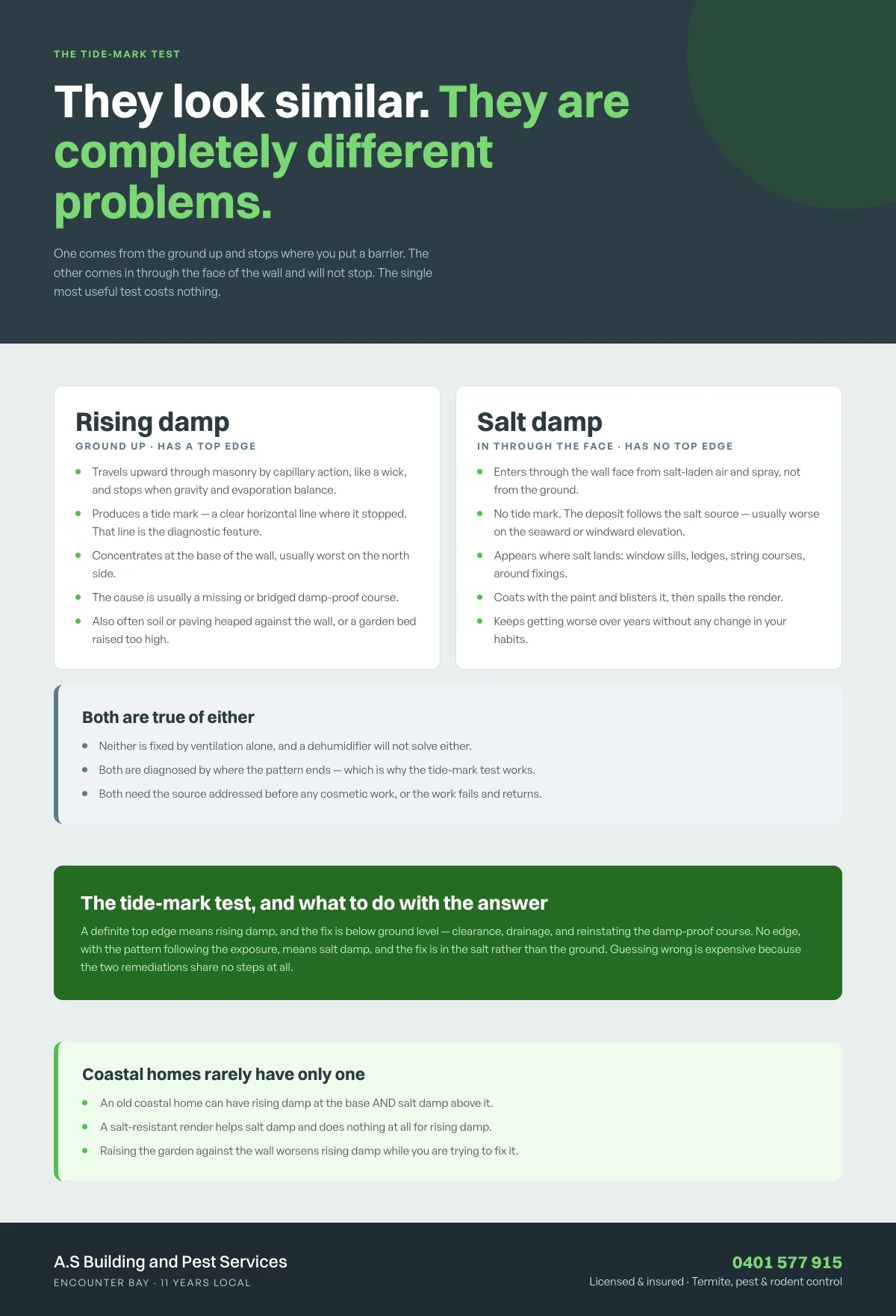
These two get confused constantly, and the confusion is expensive. They look similar from inside a room, they get described by tradespeople and sellers using the same words, and the treatments are completely different. Treat one as the other and you can spend real money fixing a wall that was never the problem.
They come from different sources, they leave different marks, and there’s a simple test that tells them apart.
Side by side
| Rising damp | Salt damp | |
|---|---|---|
| What moves | Water moving up from the ground | Water moving through the wall from a salt source |
| Source | Damp soil, failed drainage, missing damp-proof course | Sea spray and salt-laden rain on porous masonry |
| Where it shows | Base of a wall, usually all along it | Patches, often high, often near openings or exposed faces |
| The mark | A tide mark with a fairly even top edge | Blotchy, irregular staining with white deposits |
| Typical height | Low — the base, up to roughly a metre | Anywhere, including upper levels and ceilings |
| Wall surface | Blotchy, sometimes mouldy, paint failing | Blistering, flaking, crumbling, spalling, white bloom |
| Odour | Often musty | Less noticeable |
| Worse where | Ground level, north-facing, poorly ventilated | Coastal exposure, windward, driving rain |
| What fixes it | Drainage and ground-level water management | A salt source control plus letting the wall dry |
| Getting it wrong means | Treating the wall instead of the ground | Treating the wall when the salt keeps arriving |
The tide-mark test
This is the single most useful thing a homeowner can do, and it costs nothing.
Rising damp travels upward through masonry by capillary action — the pore structure draws water up like a wick, and it stops when gravity and evaporation balance it. That produces a tide mark: a stained band at the bottom of the wall with a reasonably even top edge.
The staining below that line is the part the wall has stayed wet. The line itself is where the water stopped rising.
Salt damp doesn’t do this. It enters through the face of the wall, from rain and spray, and dries where it wets out. That produces irregular blotches with defined edges and white deposits, and it can appear high on the wall or up near the roofline, not just at the base.
So: stand in front of the wall and look at the shape.
- Even line, staining from the floor up — rising damp. Look at the ground, the drainage and the damp-proof course.
- Irregular patches, white bloom, anywhere on the wall — salt damp. Look at the roof, the render, the drainage discharging against the wall.
There’s overlap, and both can be present on the same wall — common on coastal homes, where a failing damp-proof course and airborne salt are both in play. That’s worth finding out, because the two are fixed in different places.
Where rising damp and salt damp each appear
Rising damp concentrates at the base of walls, at the junction with the ground. It’s worse on the side of the house with poor drainage, where a downpipe discharges near the wall, where the ground slopes toward the building, where a garden bed has been raised against the wall base, and where ventilation has been reduced by a later addition or by sealing up vents.
Salt damp appears where the wall is wettest from outside. That means the face most exposed to driving rain and prevailing winds, parapets and ledges that hold water, window and door openings where water concentrates, and any wall where the render has cracked and let water in.
On this Peninsula that’s frequently the seaward and southern-facing walls of older homes near the coast — Victor Harbor, Port Elliot, Goolwa and the coastal parts in between.
Why it matters: the treatment is completely different
This is the reason to get the diagnosis right.
If it’s rising damp, the problem is at ground level. The fix is about water at the base of the wall — drainage, ground levels, what’s discharging where, and whether a damp-proof course is present and working. Rendering or painting the wall is treating a symptom of a ground problem.
If it’s salt damp, the problem is arriving from the air. The fix is about the salt source and the wall’s ability to dry — keeping water off the wall, letting porous masonry breathe, and repairing the surface materials once the wall is dry.
Apply a ground-level solution to a salt problem and nothing changes. Seal a salt-laden wall and it gets worse. These aren’t variations of the same job; they’re different jobs.
Damp-proof courses in older SA homes
A damp-proof course is a physical barrier built into the base of a wall to stop moisture rising through masonry by capillary action. It’s the thing that makes rising damp a managed condition rather than an inevitable one.
Older homes on this Peninsula frequently have no damp-proof course at all, or one that has been bridged. It gets bridged surprisingly often — a garden bed raised against the wall, a new concrete path or patio poured above the existing level, or a later addition that changed the ground level against the building. All of these put the damp-proof course below the new ground level and defeat it.
Where it’s present, an inspection will note whether it’s continuous and whether it’s still exposed. Where it’s absent, or where the ground has been raised against it, that’s a significant finding for a coastal property — and it’s one that can’t be seen from inside the house.
The two damps need different responses, which is why the diagnosis comes before any spend. The salt side is covered in salt damp in coastal homes. A combined building and pest inspection establishes which mechanism is active in a wall — across Victor Harbor and the surrounding coast. Get a quote before treating anything.
Frequently asked questions
Is salt damp the same as rising damp?
No. They’re different defects with different causes and are fixed in different ways. Rising damp is water moving up from the ground into the base of a wall, usually with a fairly even tide mark. Salt damp is salt-laden moisture drawn into the wall from sea spray and rain, usually showing irregular blotches and white deposits that can appear anywhere on the wall. On a coastal home both can be present at once.
How do I tell rising damp from salt damp myself?
Look at the shape of the mark. Rising damp produces an even tide line with staining below it, starting at the base of the wall. Salt damp produces irregular patches with defined edges and white salt deposits, and it can appear high on the wall or near the roofline. If the staining is at the bottom with a straight upper edge, start by looking at the ground and drainage. If it’s blotchy, higher up, or associated with spalling and flaking paint, start by looking at the roof, render and salt exposure.
Does a damp-proof course fix rising damp?
A damp-proof course is what prevents rising damp, so where one is missing or has been bridged by raised ground levels, it’s central to the problem. But it only works if the rest of the ground-level water management is right — drainage, ground slopes and downpipe discharge all still matter. Installing a barrier where water is still being directed at the wall won’t solve it.
Adam Shaw — Owner
Licensed building and pest inspector with 11+ years of experience protecting Fleurieu Peninsula homes. Based in Encounter Bay, serving Victor Harbor, Goolwa, and surrounding areas.
More Helpful Articles
Explore our blog for practical guidance on building inspections, pest control, and property maintenance.
View All ArticlesNeed a Building or Pest Inspection?
Get your free quote today — thorough inspections, transparent pricing, and 11 years of local expertise.