Are Building and Pest Inspections Worth It?
The honest answer — what an inspection catches that a viewing never will, when it's worth less, and what skipping it actually costs you.
The honest answer — what an inspection catches that a viewing never will, when it's worth less, and what skipping it actually costs you.
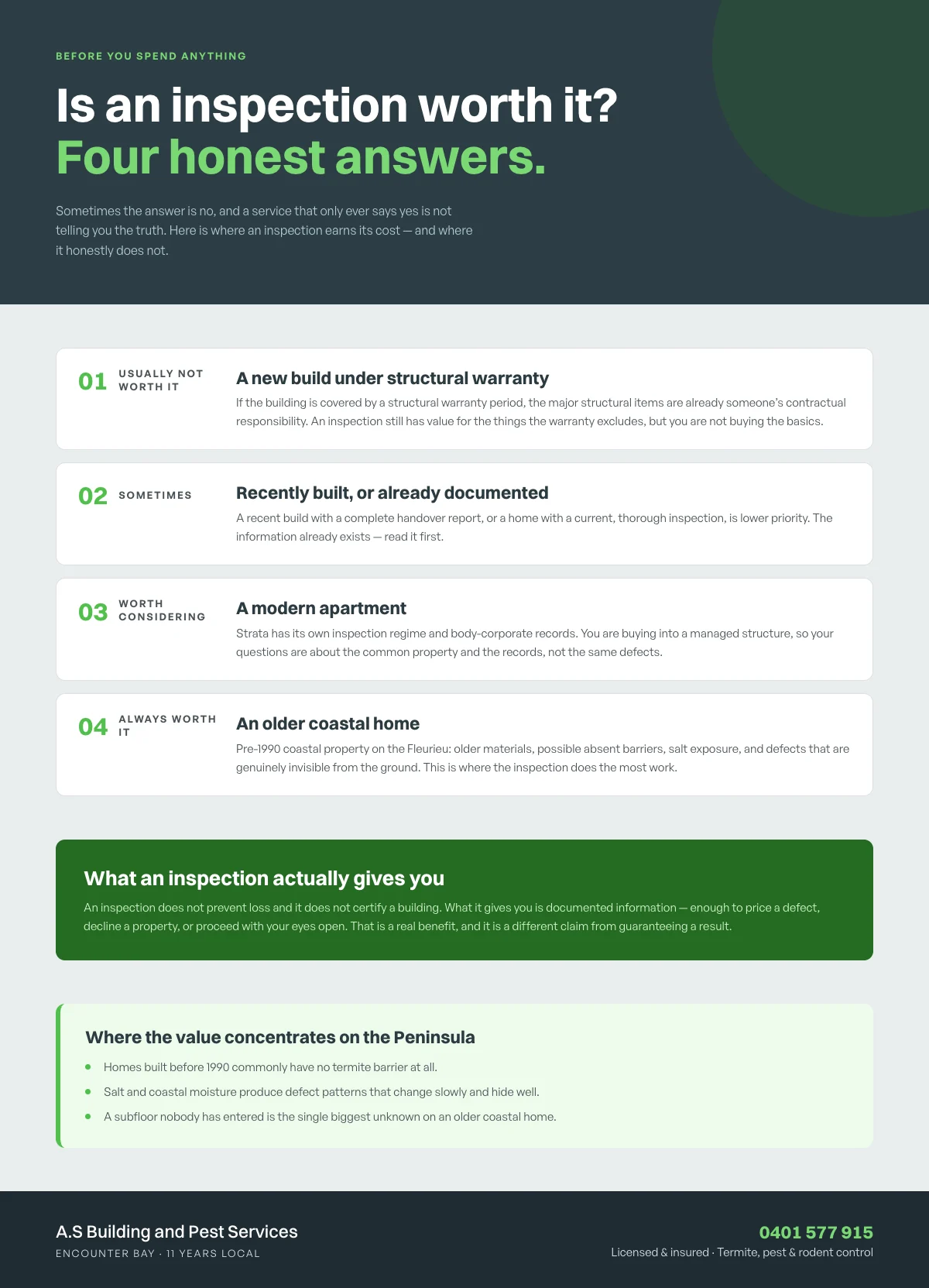
Sometimes. Not always — and the situations where it isn’t worth it are real and worth naming. Anyone who tells you every property needs one is selling you something.
The honest answer is that an inspection is worth it when the property has things you can’t see from the driveway, and less valuable when it doesn’t. Everything below is about working out which one you’re looking at.
The short answer
A building and pest inspection is worth it when three conditions are true at once:
- The property is old enough or unusual enough to have hidden problems. Older coastal homes on the Fleurieu qualify on both counts.
- You can’t undo the decision once you make it. Buying is the point.
- The cost is small relative to the purchase price. It always is. The inspection is a rounding error on a house purchase.
Miss any one of those and the calculation changes. That’s the whole argument.
What it catches that a viewing never will
A viewing is thirty minutes, from the front, in the rain. It confirms the house exists. It doesn’t confirm the house is sound.
The things a viewer reliably can’t assess:
What’s behind the walls. Wall cavities, under floors and inside the roof space are where serious defects live, and they’re invisible from the property. Termites work almost entirely out of sight. Timber decay in a roof void can be well advanced with nothing at all showing on the ceiling below.
What the ground is doing. Subfloor conditions — ventilation, moisture, whether timbers are in contact with soil, whether drainage is failing — are only visible by getting into the subfloor.
What the roof is actually doing. Tiles can be cracked and slipped across a whole roof with the line reading intact from the street, and the sarking beneath them can be perished.
Whether the wall base is still attached. Where ground has settled away from brickwork, the framing and the tie-downs can be exposed, and on a limestone site the erosion can be substantial. You can’t see this from a street view.
What the previous owner did and didn’t maintain. Roof, gutters, drainage, repointing. A report records condition; a viewing records appearance.
These aren’t rare problems on this Peninsula. They’re what an older coastal home is. A viewing doesn’t touch any of them.
When it’s worth less
Being straight about this is what makes the rest of it credible.
A new build under structural guarantee. If the building is covered by a structural warranty period, the major structural items are already someone’s contractual responsibility. An inspection still has value for workmanship and defects the warranty may exclude, but the marginal return is lower.
A recently built property with a comprehensive building certificate. Similar logic, though certificates and inspections check different things.
Where a thorough independent report already exists and is recent. If a building report was completed in the last few months by an independent inspector, and you’re buying the same property, you gain little from a second identical report.
A staged or freshly renovated property. Where anything has been recently painted, rendered, tiled or fitted out, you’re being asked to rely on the fact that the cosmetic layer is sound. A well-run renovation improves things, but it also improves how the property looks. This is a reason to look more carefully, not less.
Very short-term or speculative buyers. If you intend to flip the property in months and are comfortable with the risk, the inspection is a decision about risk appetite rather than one with a correct answer.
The real cost of skipping it
The usual framing is “you might miss something”. The more accurate framing is what happens when you find it later instead.
A defect discovered during a pre-purchase inspection is a negotiation with a vendor who wants the sale to complete. The same defect discovered eighteen months after purchase is a repair you pay for in full, at contractor prices, with no offset against the purchase price and no ability to walk away.
That asymmetry is the actual value of inspecting. It’s not that the inspection finds problems — most inspections find a handful of minor ones. It’s that findings made before you commit are almost always cheaper for you to deal with than the same finding afterwards.
There’s a second cost people underestimate: living with an unknown. Knowing your roof void is sound is worth something even when nothing is wrong.
What we’d say if we were on your side
Skip the inspection if the property is new, currently under warranty, or already has a recent independent report you trust.
Do it if you’re buying an older home anywhere near the coast — which is most of the stock on the Fleurieu Peninsula — because the defects that matter on those homes are precisely the ones you can’t see from the driveway.
If you do get one, read it properly before you negotiate. That’s covered in detail in our guide to what a building and pest report actually contains, because knowing which findings matter and which are cosmetic is the part most buyers skip, and it’s where the money is.
The numbers that decide whether an inspection pays for itself are the ones a report puts in your hands. For the money side, see what an inspection costs in Victor Harbor; for the buyer’s playbook, when you can renegotiate after an inspection. Book a combined building and pest inspection — get a quote.
Frequently asked questions
Are building and pest inspections worth it?
It depends on the property, and the honest answer is that most buyers wouldn’t regret having one. An inspection is worth the most on older, coastal or unusual properties where serious defects are likely to be hidden behind walls, under floors or inside the roof space — which is most of the older housing stock around Victor Harbor, Port Elliot and Goolwa. It’s worth less on a new build currently under structural warranty, or where a recent independent report already covers the property. The strongest argument for one isn’t that it finds problems, but that any finding made before you commit is cheaper for you to deal with than the same finding afterwards.
Do inspections find problems that aren’t obvious?
Yes, and that’s what they’re for. Termites, timber decay, moisture behind walls, subfloor ventilation problems, drainage failures, wall base erosion and roof covering defects are all routinely present without any visible sign from the property or from inside the house. A viewing surveys appearance; an inspection accesses the spaces where the consequential problems actually are.
What if the inspection finds nothing serious?
That’s a good outcome and it’s the most common one on a reasonably maintained property. What you’ve actually bought is certainty, and a documented record of the building’s condition on the day you bought it — which matters later when something comes up and you need to establish whether it was already there.
Adam Shaw — Owner
Licensed building and pest inspector with 11+ years of experience protecting Fleurieu Peninsula homes. Based in Encounter Bay, serving Victor Harbor, Goolwa, and surrounding areas.
More Helpful Articles
Explore our blog for practical guidance on building inspections, pest control, and property maintenance.
View All ArticlesNeed a Building or Pest Inspection?
Get your free quote today — thorough inspections, transparent pricing, and 11 years of local expertise.