Can You Negotiate After a Building Inspection? Yes — Here's How
Yes — and the evidence that does it. Which findings actually move a price, how to present them, the SA cooling-off deadlines, and when to walk away.
Yes — and the evidence that does it. Which findings actually move a price, how to present them, the SA cooling-off deadlines, and when to walk away.
Yes, you can negotiate after a building inspection. This is the moment where an inspection turns into money, and the mechanism is straightforward: the report gives you evidence about cost, and you use it to change the price before you settle.
The part most buyers get wrong isn’t whether they can negotiate. It’s that they negotiate with a list of findings instead of a list of costs.
Short answer — how to negotiate after a building inspection, and why it works
You can negotiate, and it works, for three reasons.
The vendor doesn’t know what they don’t know. Most sellers have never had their subfloor inspected, their roof void opened, or their wall base looked at. A finding they can’t explain is a finding they have to respond to.
Findings have an economic value. A structural issue isn’t a matter of taste — it’s a repair the buyer is otherwise going to pay for. That difference between “we don’t like the green” and “we’ll have to pay to fix the roof framing” is the entire negotiation.
Nothing is signed yet. Before you settle there’s no contract that binds you to proceed. That leverage doesn’t exist after settlement.
The caveat: negotiation requires the finding to be real, material and defensible. All three.
Which findings actually move a price
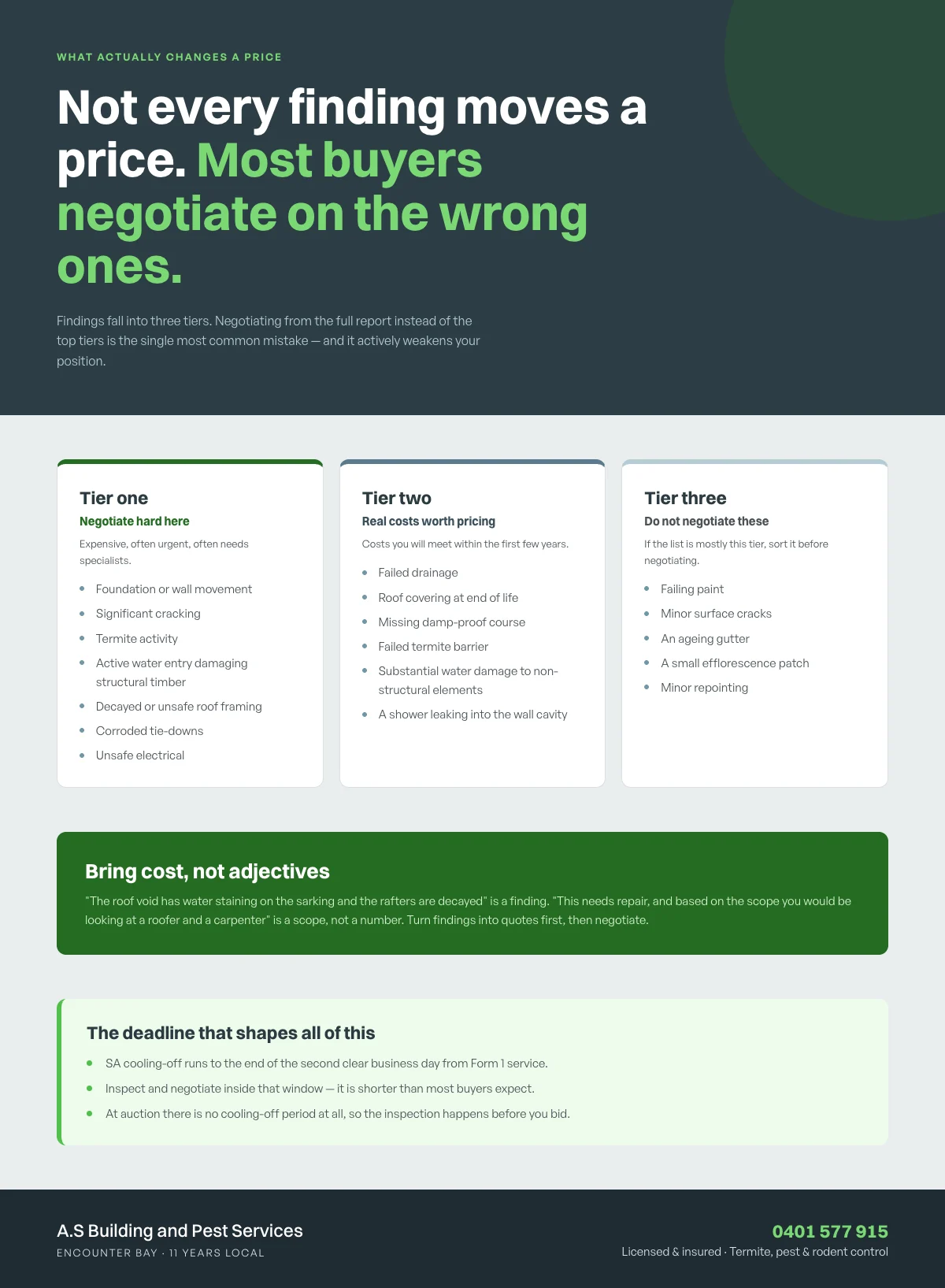
Findings fall into a clear hierarchy, and most buyers negotiate on the wrong tier.
Tier one — structural and safety. Foundation or wall movement, significant cracking, termite activity, active water entry with damage to structural timber, decayed or unsafe roof framing, corroded tie-downs, unsafe electrical. These move price because they’re expensive, often urgent, and often require specialists. This is where negotiation is strongest.
Tier two — significant functional defects. Failed drainage, a roof covering at end of life, missing damp-proof course on a masonry home, a failed termite barrier, substantial water damage to non-structural elements, a shower leaking into the wall cavity. These move price because they’re real costs the buyer will meet within the first few years.
Tier three — maintenance and cosmetic. Failing paint, minor surface cracks, an ageing gutter, a small efflorescence patch, minor repointing. These don’t move a price. Listing thirty of these in a negotiation actively undermines your credibility, because it signals you haven’t sorted them and are simply asking for money.
The mistake is negotiating from the full report rather than the top two tiers. Sort first, then negotiate.
How to present it to the agent or vendor
Bring cost, not adjectives. The single biggest difference between a successful and an unsuccessful negotiation is whether you arrive with costs or with complaints. “The report says the roof void has water staining on the sarking and the rafters are decayed” is a finding. “This needs repair, and based on the scope you’d be looking at a roofer and a carpenter” is a number.
Get quotes where the amount is significant. For a genuine tier-one finding, an actual quote from a trade gives you a defensible figure. It’s usually worth paying for one quote on the biggest item rather than guessing at all of them. Your building inspection report is the document that tells you whether you need the quote.
Separate “fix” from “monitor”. Some findings need attention and some need watching. A vendor is far more receptive when you ask them to price the one that genuinely has to be done, because it demonstrates you aren’t just escalating.
Be specific about what you’re asking for. A specific reduction for a specific, priced defect is negotiable. A general feeling that the house is “worth less than that” isn’t.
Don’t negotiate on inspection costs. That’s the vendor’s to decide and it’s rarely the real issue. The findings are the lever.
Assume the vendor won’t volunteer anything. The most common outcome is that the vendor already knows about the item and has priced around it. Discovering what the vendor already knows, rather than what the report found, is often where the money is.
The SA cooling-off period and your deadlines
A contract of sale for land in South Australia is generally subject to a cooling-off period, during which the purchaser can withdraw for no stated reason.
The rule is specific. The purchaser’s rights to “cool off” are set out in Part B of the Form 1 under the Land and Business (Sale and Conveyancing) Regulations 2025 (SA), Schedule 1. The period expires at the end of the second clear business day from the day the Form 1 is served on the purchaser. Those two business days don’t include weekends, public holidays, or the day of service.
What that means practically: your inspection — and any negotiation arising from it — happens inside a two-business-day window. That’s shorter than most buyers expect. Sign, inspect, negotiate, then let the period run. Once it has expired, withdrawing is no longer available.
To cancel, the purchaser serves written notice on the vendor or their agent stating they don’t wish to be bound. No reason has to be given. Notice can be given in person, by leaving it at the agent’s place of business, by registered mail, or by email — and in a dispute the purchaser has the onus of proof, so keep a copy and the evidence of sending it.
If the property was bought at auction, there’s no cooling-off period at all. If you’re buying at auction, the Form 1 should be reviewed before you bid, because after that there’s no statutory way back.
✅ VERIFIED against the SA Law Handbook (Buying a home → After signing the contract → Cooling-off period, lawhandbook.sa.gov.au/ch23s08s08s01.php), which cites the Land and Business (Sale and Conveyancing) Regulations 2025 (SA) Schedule 1. The previous draft deliberately described this mechanism “qualitatively” with no period stated — that caution was justified, because the previous note told the writer not to add a period from memory. It’s now sourced.
This is a general statement of a statutory deadline, not legal advice. The Regulations are the operative document and a SA conveyancer should confirm the position for a specific contract. The draft asserts no case-specific outcome, no deposit amount beyond the statutory framing, and no obligation on any party.
When NOT to negotiate — and when to walk away
Don’t negotiate when the finding is trivial. A list of small maintenance items reads as nitpicking and costs you leverage.
Don’t negotiate when You’ve already decided to buy at any price. If the amount is below your threshold for withdrawing, negotiation is a discussion about who absorbs a small cost. Save the capital for a property you might actually walk away from.
Walk away when the findings are structural, numerous, and interact — which is more than the sum of the parts. A compromised subfloor, decayed roof framing and a corroded tie-down are three findings and one serious problem, and it should be priced as one.
Walk away when the vendor’s response tells you something. Deflecting, minimising, or producing “we’ve always maintained it” without evidence are informative.
Walk away when you can’t resolve what couldn’t be inspected. An inaccessible subfloor on a house with visible ground problems is an unknown, and the right response to an unknown at the point of commitment isn’t a discount.
Walk away when the seller refuses access in the first place. If an inspection wasn’t permitted, nothing after that point is reliable.
For what the inspection itself costs, see how much a building and pest inspection costs in Victor Harbor; for what happens on the day, what to expect during a pre-purchase inspection. A combined building and pest inspection gives you the evidence the Form 1 process needs — get a quote.
Frequently asked questions
Can you negotiate price after a building inspection?
Yes, and it’s one of the main reasons to inspect before you commit. The report gives you documented evidence about the condition and cost of the property, which you can use to ask the vendor to change the price before you settle. It works best when you present specific, costed defects rather than a general list of complaints, and when the findings are structural or functional rather than cosmetic. The leverage exists because nothing is signed yet — that leverage disappears once the contract is final and the cooling-off period has run.
How much can you negotiate off after an inspection?
It depends entirely on the cost of the findings, and there’s no standard percentage. The amount is determined by what the defects would cost you to remedy, which is why getting a quote on a significant finding is worth doing — it converts a finding into a defensible figure. Cosmetic and maintenance items generally won’t move a price; structural and significant functional defects can. Negotiation on a long list of minor items usually weakens your position rather than strengthening it.
Does negotiating after an inspection delay settlement?
It can, and that’s a trade-off you should expect. Resolving a significant structural finding usually means a trade quote and a conversation with the vendor, and if you need advice on whether a defect is material, an engineer’s opinion. That takes time, and on a property under a cooling-off period it’s time spent inside a window you want to make your decision inside. The alternative is settling faster and absorbing whatever you didn’t negotiate. Worth deciding which you’re doing before you sign rather than after the report arrives.
Adam Shaw — Owner
Licensed building and pest inspector with 11+ years of experience protecting Fleurieu Peninsula homes. Based in Encounter Bay, serving Victor Harbor, Goolwa, and surrounding areas.
More Helpful Articles
Explore our blog for practical guidance on building inspections, pest control, and property maintenance.
View All ArticlesNeed a Building or Pest Inspection?
Get your free quote today — thorough inspections, transparent pricing, and 11 years of local expertise.