Spider Control in Coastal SA: Why Salt Air Makes It Worse
Why coastal SA properties get more spider activity, which species you actually see, what DIY spraying misses, and how to make a home less attractive to them.
Why coastal SA properties get more spider activity, which species you actually see, what DIY spraying misses, and how to make a home less attractive to them.
Coastal spider control isn’t the same problem as inland spider control, and generic Adelaide advice doesn’t transfer. Not because the spiders are different — mostly they’re the same species — but because the conditions that concentrate them are.
Near the coast, the food, the shelter, the water and the temperature all push spider activity toward the building. That’s why people say they’ve got more spiders since they moved to the coast, and it’s usually true, and it’s not because anything about the house is different.
Why coastal properties get more activity
Four conditions, and the coast changes all four.
Food. Spiders follow insects, and insects follow light, water and vegetation. A garden, a deck with lights on, an outdoor dining area and standing water around a coastal home all concentrate prey in a small area — right where people sit in the evenings.
Shelter. Spiders need somewhere to hide during the day and nest. Coastal properties have dense vegetation, garden beds, fencing, outdoor furniture, sheds, wood piles and a lot of covered outdoor space. Hot, dry inland conditions push a lot of insect activity away from buildings; coastal humidity keeps it close.
Water. Retaining and irrigation are features of coastal gardens. Reliable water near a structure means more insects, which means more spiders.
Mild temperatures. Coastal SA has fewer extreme temperature swings than inland areas. Spiders that would be inactive through a hot inland summer are still active near the coast.
None of this means coastal properties have a specific spider problem inland ones don’t. It means the same species are more active and more visible — which is the actual complaint people bring to us.
The species you’ll actually see
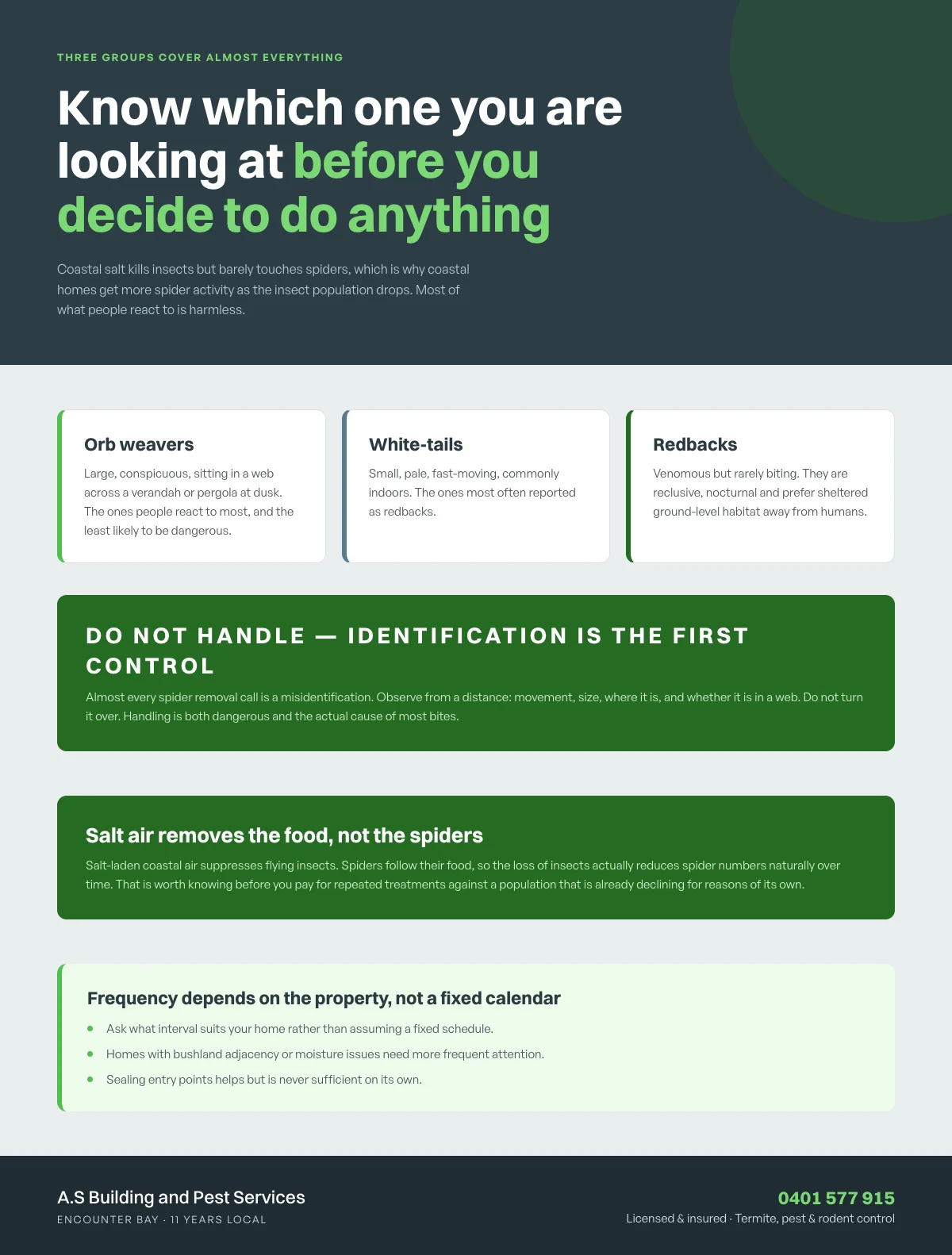
Three groups cover almost everything a Fleurieu homeowner will find.
Orb weavers. Large, conspicuous, sitting in a web across a corner of a verandah, pergola or garden path at dusk. These are the spiders people react to most and the ones least likely to be dangerous. They’re beneficial — they eat the insects that are otherwise biting people — and they’re outside, usually above head height, and not seeking contact with people.
White-tails. Small, pale, fast-moving, commonly found in sheds, under eaves, behind shutters and in leaf litter. Two things matter about white-tails: they’re commonly confused with the redback, and they’re far more likely to be indoors. The confusion matters because most “I think I have a redback in the shed” reports are white-tails.
Redbacks. The one to actually be careful about. Females are the ones that matter, they’re well-camouflaged, and they’re typically found in sheltered, undisturbed, ground-level places — under eaves, in garden clutter, in firewood stacks, behind outdoor furniture and in stored outdoor equipment.
What DIY spraying misses
Over-the-counter spraying works on the spiders you can see, and misses most of what matters.
Most of the population is elsewhere. Spiders concentrate in shaded, sheltered, undisturbed corners — under eaves, in sheds, behind downpipes, inside stored furniture, in the roof void, in dense garden beds. A can of spray in a room addresses a fraction of them.
It treats symptoms, not the cause. Residual surface spraying kills spiders that cross the treated surface. It doesn’t remove the food source, change the shelter, or address the areas where the real population is living. Expect a reduction that fades.
Repeated broad-spectrum spraying can affect the predators too. Spiders eat the insects that bother people; removing predators along with targets can allow some insect populations to increase.
It doesn’t reach voids. Subfloors, roof voids, wall cavities, under decks and inside outdoor storage are where a large proportion of spider activity sits, and none of it’s reachable from a hand-held can.
Timing. Domestic spraying is often applied when spiders are already visible and comfortable. Professional treatment is timed to life-cycle stages where it’s far more effective.
None of this is an argument against doing it yourself for a minor problem. It’s an argument about what a spray can and can’t reach.
What professional spider control involves
Inspection first. What species, where, how many, and what’s driving the activity. Species matters — an orb weaver problem and a redback problem are different problems with different responses.
Targeted treatment. Treating the areas where the spiders are and where the food is, not the areas you walk through.
Environment management. Reducing shelter and food. This is the part that makes the difference, and it’s largely advice and habit change rather than chemistry.
A schedule, not a one-off. Because the underlying conditions are continuous, treatment works as a programme with a frequency rather than a single application.
Re-entry and safety. Product choice, concentration, drying times, and what people and animals can be doing in the treated area afterwards.
Safety for children and pets
This matters more at a coastal home, because that’s where children actually are — in the garden, on the deck, in the pool area, in the shed.
General principles:
- Keep children and pets out of treated areas until the product label says it’s safe. The label is the authority and it differs by product. Don’t assume.
- Don’t treat where food is grown. Spray and runoff on edible plants is a reason to be careful about product choice, not to work around the label.
- Don’t treat over fish ponds, water bowls or bird baths without checking suitability.
- Keep pets off wet treated surfaces. Dry doesn’t necessarily mean safe.
- Store products where children can’t reach them, and keep containers as labelled.
- Don’t spray above head height or into air where people are breathing it.
Don’t attempt to handle or kill any spider you can’t identify with confidence. If you aren’t sure what it’s, leave it and get it identified.
Managing the environment, not just the spiders
The changes that reduce numbers most are unglamorous and mostly free.
Reduce the shelter. Clear stored outdoor items, move wood away from the house, keep the shed tidier than it needs to be, avoid dense ground cover against walls.
Reduce the light and the water. Outdoor lighting attracts the insects that attract the spiders. Fix leaking taps and improve drainage near structures.
Reduce the prey. Manage the things feeding them — broader pest management, and where the real leverage is.
Change the outdoor use pattern. If the deck is lit every evening, the deck will have spiders.
Do it seasonally and slightly ahead. Activity follows temperature and humidity, so a change in conditions does what a calendar reminder doesn’t.
The honest summary: you can’t make a coastal home spider-proof without changing what it’s. What you can do is remove the conditions that concentrate them, and treat what remains properly.
Identification comes first, treatment second — for the prevention side, see how to prevent spiders in your Victor Harbor home. We provide spider management around Victor Harbor when the population needs it. Get a quote if the webs are winning.
Frequently asked questions
How often should I spray for spiders?
For a coastal property with persistent activity, treating once and expecting it to hold is the common mismatch. Effective control generally works as a programme rather than a single application, because the conditions driving the activity — shelter, water and insect prey — are continuous. If you’re spraying yourself, expect to be doing it repeatedly and expect the effect to diminish between treatments. A professional assessment is worth considering before you buy several cans a year, because it should establish what species you actually have and where the population actually sits. If you’re only seeing the occasional spider in a garden, you may not need treating at all — that’s a real and common answer.
Are spiders a sign of a bigger pest problem?
Often, yes, and that’s the more useful way to think about it. Spiders feed on insects, so a high spider population usually points to a high insect population. The spiders are a symptom; the insects are the problem. Managing the insects — flies, mosquitoes, cockroaches, ants around lights and food waste — usually reduces the spiders as a consequence, which is why treating spiders alone tends to be disappointing.
Adam Shaw — Owner
Licensed building and pest inspector with 11+ years of experience protecting Fleurieu Peninsula homes. Based in Encounter Bay, serving Victor Harbor, Goolwa, and surrounding areas.
More Helpful Articles
Explore our blog for practical guidance on building inspections, pest control, and property maintenance.
View All ArticlesNeed a Building or Pest Inspection?
Get your free quote today — thorough inspections, transparent pricing, and 11 years of local expertise.